
Education in America, and American democracy itself, are at an inflection point. Public schools are confronting deep inequities in opportunity and outcomes, persistent funding shortfalls, political conflict over governance and curriculum, teacher shortages, and growing disengagement among students and families, all contributing to declining public trust. At the same time, many communities are increasingly searching for alternatives to traditional public schooling, reflecting a broader erosion of confidence in schools as vital community institutions.
Education for Democracy, a project of Harvard Law School’s Youth Advocacy & Policy Lab (Y-Lab), is responding to these challenges through a distinctive combination of constitutional litigation and community-driven advocacy. It seeks to use state constitutional rights as legal tools for rebuilding public education through participatory litigation, an emerging approach that treats plaintiffs and other stakeholders as genuine collaborators in shaping legal strategy, developing remedies, generating public engagement, and defining what constitutional compliance should look like in practice.
With the help of Y-Lab’s Strategic Litigation Clinic, Education for Democracy is currently conducting two large, complex state constitutional litigations that have the potential to establish groundbreaking precedents capable of reshaping education advocacy nationally.
KSVT v. Commonwealth of Kentucky asks the court, on behalf of the Kentucky Student Voice Team, a statewide youth-led organization, and 13 individual student plaintiffs, to analyze the current extensive lack of compliance with the Kentucky Supreme Court’s landmark equity and adequacy decision in Rose v. Council for Better Education (1989) and to ensure sustained compliance with court orders and students’ educational rights.
In New York, A.B. v. Hochul seeks to establish explicitly for the first time that the state constitutional right to a sound basic education extends to all students in the state, including those who attend nonpublic schools, and that the state is obligated to ensure these schools provide their students a constitutionally adequate education.
These cases serve as laboratories for refining constitutional theories and participatory litigation practices that can inform future advocacy efforts. Their impact could extend far beyond the states in which they were filed by helping establish new constitutional pathways for strengthening public education nationwide.
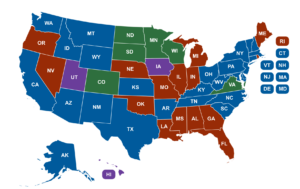 |
Schoolfunding.InfoRead about state court decisions on school funding across the country. |